

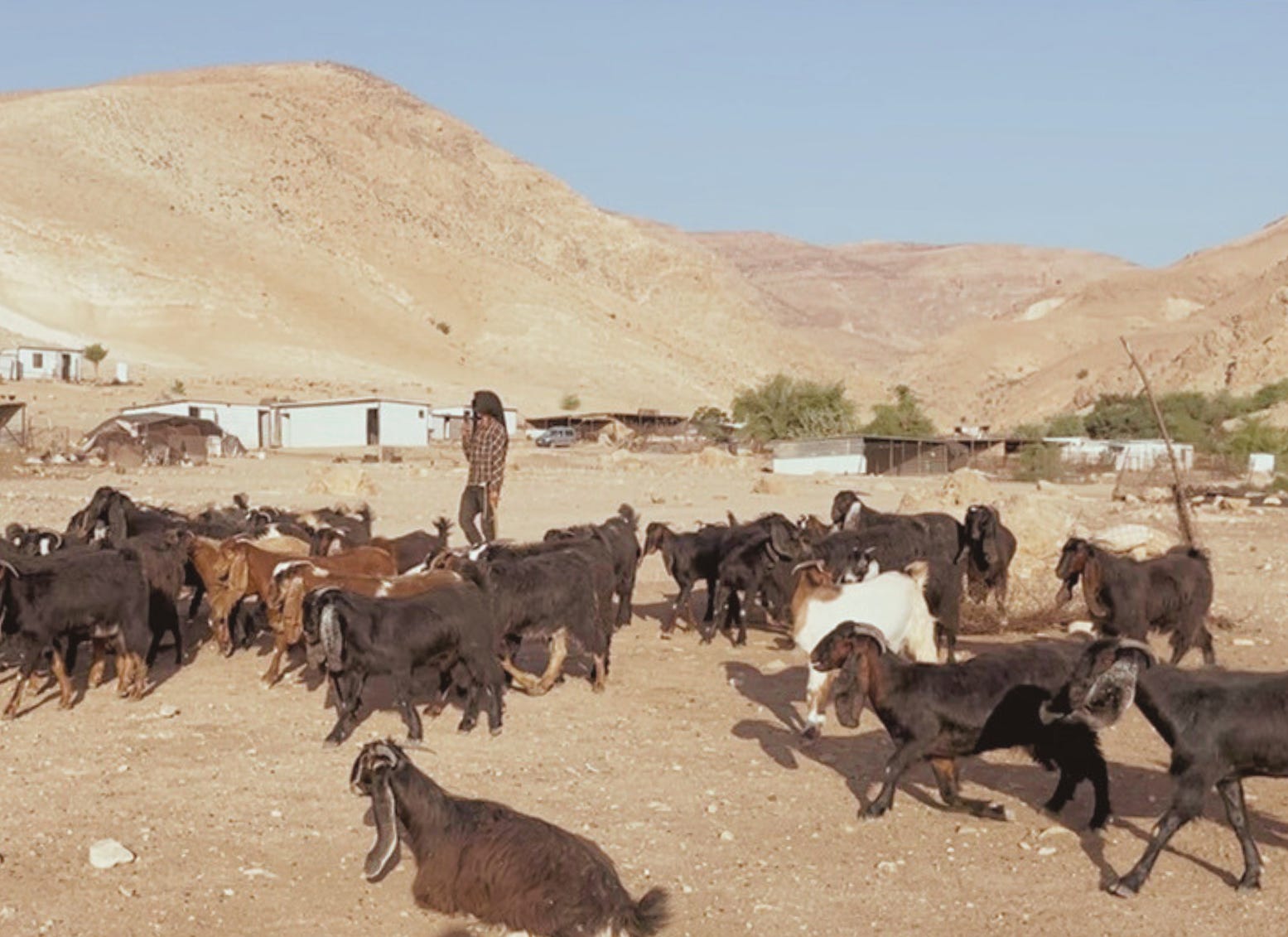
He throws a shirt over his head to hide his face and holds his cell phone out in front of him as he approaches us. We watch each other steadily from about twenty feet apart, his herd of goats moving between and around us. I feel the urge to speak to him—a teacherly instinct, honed over twenty years of checking in on despondent teenagers—but the activists advise me otherwise.
This boy, who appears hardly fourteen, is an Israeli settler. He lives without parents or family in an isolated structure set into the dry, rocky hillside above Ras ‘Ein al ‘Auja, a small Palestinian shepherd community in the occupied West Bank. Each morning he emerges with the same purpose: to provoke fear and assert domination over his neighbors.
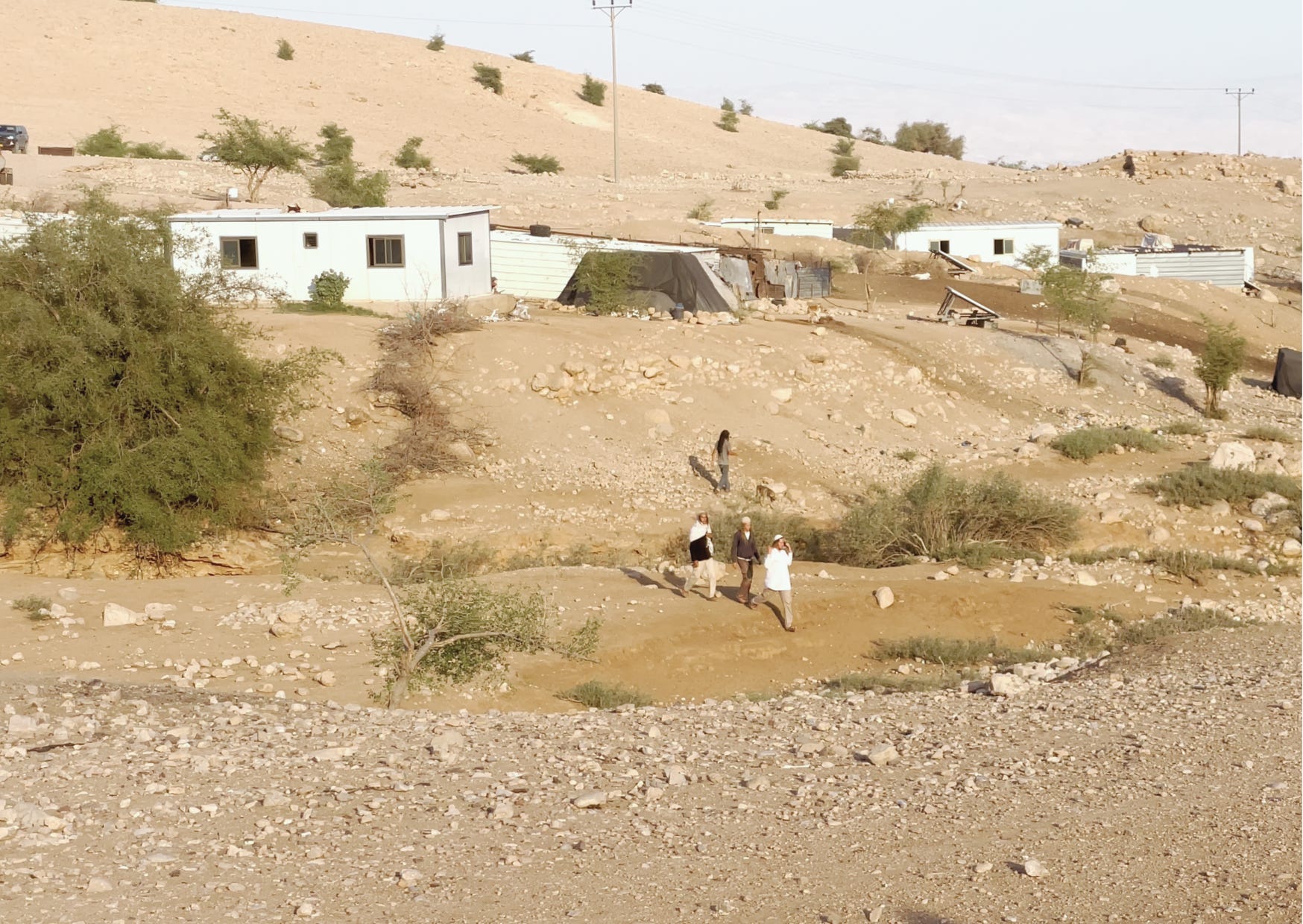
Neighbors is misleading; it suggests mutual relation, which does not exist here. About 135 families, descendants of Bedouin communities expelled from the Negev during the 1948 Nakba, have lived in Ras ‘Ein al-’Auja for over fifty years. The arrival of a small outpost of teenage Israeli settlers two years ago marked the beginning of a campaign to forcibly displace them.
Last September, leveraging my status as an American Jew, I served in what is called “protective presence.” I placed my body between Israeli settlers and Palestinian families in Ras ‘Ein al ‘Auja as a nonviolent attempt to deter settler violence. What unfolded before me was a microcosm of ethnic cleansing in real time.
Shortly after arriving in the village from Jerusalem with a group of young Israeli Jews from Bnei Avraham—the activist wing of Smol Emuni, a movement of observant Jews advocating for justice and equality for Palestinians—we received a phone call: a teenage Israeli settler had entered a home and was harassing Palestinian children.
The activists moved quickly and calmly, deciding who would respond. Two ran to the home to de-escalate the encounter, while the rest of us unloaded our bags in our temporary base in the village. Later, we watched a video: the settler, no more than seventeen, pressed aggressively against my friend, who spoke firmly in Hebrew but did not retaliate. Watching the footage, it struck me viscerally: this was not random bullying, but intimidation sanctioned and enabled by the state, driven in particular by far-right Israeli politicians.
Any reasonable adult would recognize whose behavior required intervention and whose safety required protection. But here, in a landscape shaped by systematic territorial dispossession, that moral logic is not merely confused, it is deliberately inverted.
The settler, unkempt, his knotted hair dangling from under his black hoodie, taunted and provoked at will. His behavior recalled Lord of the Flies: boys left to govern themselves, cruelty unchecked and quietly rewarded. That’s because his bullying is backed by settler religious organizations that recruit and exploit vulnerable Jewish youth, positioning them as instruments of land seizure under the guise of religious entitlement.
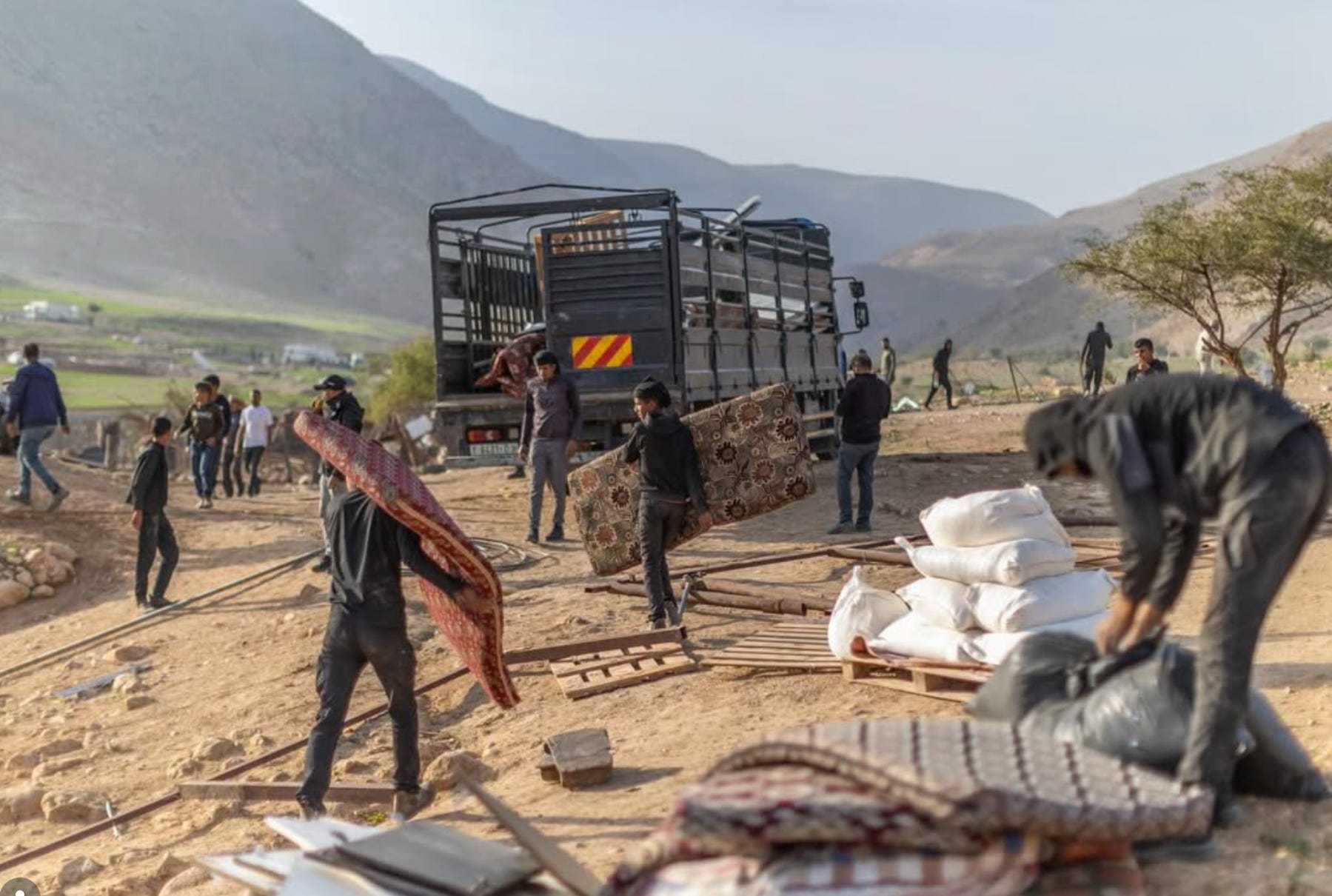
As I write this essay in January 2026, the Palestinian families of Ras ‘Ein al-’Auja are being driven from their homes. Settler violence has escalated, effectively destroying the village. The forced displacement of this Palestinian shepherd community in the southern Jordan Valley is not a singular act, but a coordinated effort to permanently remove Palestinians from Area C, which remains under full Israeli control.
None of this is news, either literally or figuratively. The daily realities of Israeli apartheid rarely appear in mainstream media, whether in Israel, Europe, or in the United States—which funds it extensively. And the American Jewish communities in which I was raised have largely doubled down on denial. They refuse accountability in the face of the genocide in Gaza and the ongoing displacement of Palestinians in the West Bank.
I know all too well that words like ethnic cleansing, genocide, occupation, and apartheid can trigger contraction and defensiveness among Jews who still hold tightly to Zionist narratives—including much of my family and the friends I grew up with. I understand this reaction intimately; it took me decades to unlearn the ideological forces and to acknowledge the inherited trauma that shaped my own psychological and somatic responses.
But there are no other words available. These terms exist because they name specific crimes against humanity, and to refuse them would be to deny what I witnessed with my own eyes.
Yet there is another challenge, one less often addressed, because acknowledging it would collapse the moral compass on which so much of Judaism claims to rest: the Jewish ethic, “Love your neighbor as yourself” (Leviticus 19:18), a principle in stark contradiction with Israeli expansionism.
It is so glaringly obvious that naming it almost feels stupid. Yet this is precisely the work these teenage settlers are trained to do: act in the opposite direction, treating their Palestinian neighbors with total contempt and violence. This, of course, mirrors the functioning of the Israeli government and military. But what becomes clear when witnessing this behavior on the ground, especially when it is carried out by children, is that these settler youth have themselves been harmed: neglected, poorly educated, subjected to violence within their families, and exploited by state structures. That harm manifests in the ways they abuse those around them, and likely one another.
As the sun set that Friday evening in Ras ‘Ein al-’Auja, the activists and I gathered for Shabbat in a three-walled structure rented from a local Palestinian. A simple kitchen had been set up; mattresses were spread across the cement floor. Facing the village, and beyond it a mountain range dotted with tiny lights in Jordan, we lit the candles, sang familiar melodies, recited the blessings over challah and wine, and shared a pre-prepared dinner together. Practicing Judaism here was not about claiming land, but about grounding ourselves in spiritual practice and ethical relation.
I didn’t sleep much that night; it’s hard to rest when you feel chaos could erupt at any moment. A barking dog or flash of headlights might signal the approach of an Israeli settler. That is their purpose: to unsettle.
The next morning, we were called to place ourselves between a young Israeli settler and a Palestinian family, as he encroached on their land with his flock of goats, a subtle method often used to intimidate. Four of us, all Jewish women, spaced about ten feet apart to form a boundary, keeping roughly thirty feet from the teenager and his herd. For several hours under the hot desert sun, we moved alongside him and the goats. We filmed him, and he filmed us in return, a deliberate tactic settlers use to portray activists as unruly anarchists, despite our visibly calm behavior.
Simply being present often deters settlers from acting violently.
Midday, when the sun was at its highest, even the settlers took a break. In these moments of rest, we spent time with the local families—playing soccer and other games with the children, and sharing tea, food, and stories with the adults. Most of the Israeli activists spoke Arabic, and everyone knew each other by first name. For the past year, the group had been coming to Ras ‘Ein al ‘Auja every Shabbat, perversely, the time when settlers are most active in their intimidation, despite Shabbat being a day of rest for observant Jews.
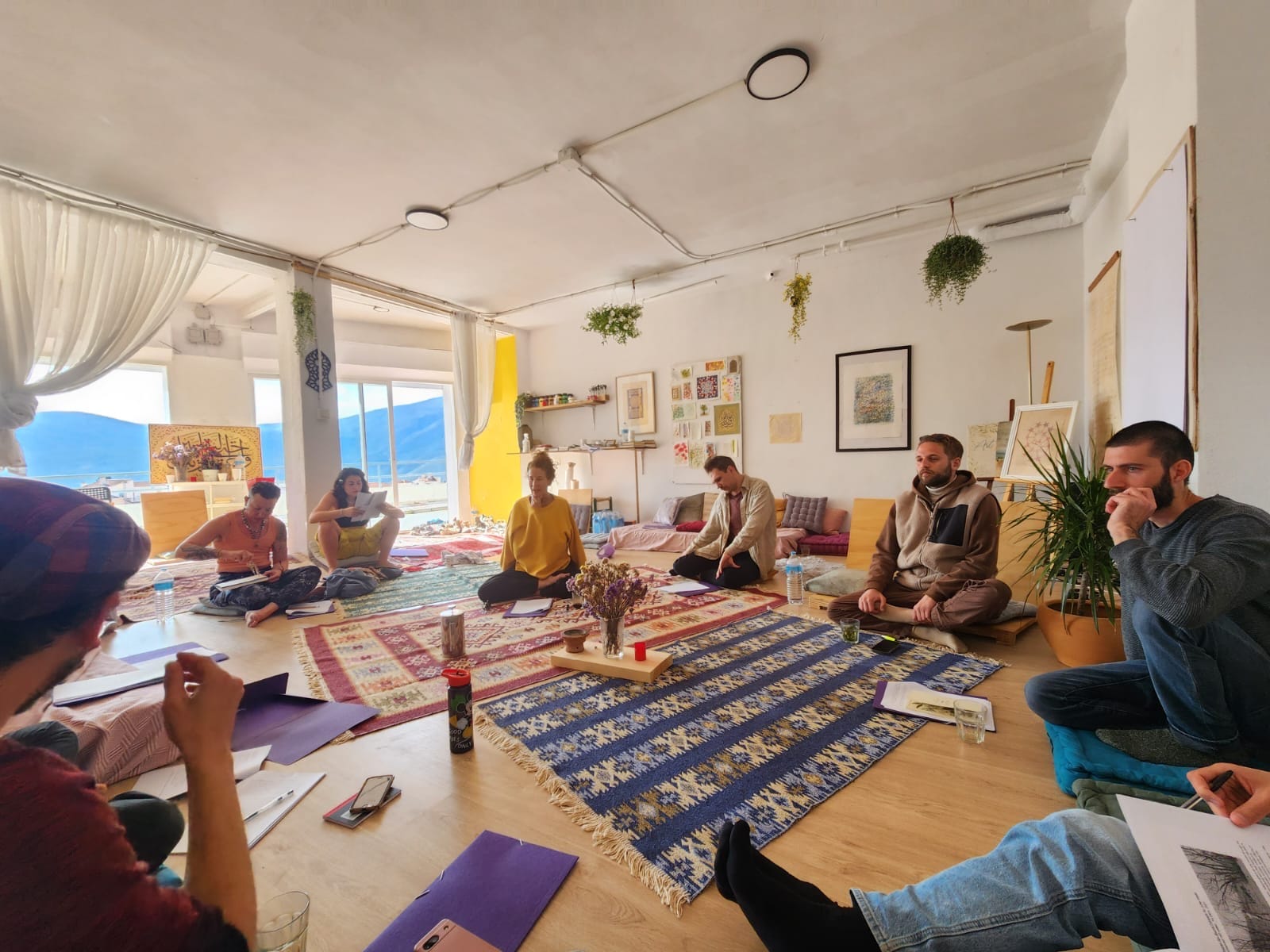
I first met this group of activists in April 2025, in the Alpujarra Mountains of Andalucía, at a Passover retreat devoted to decolonizing Judaism. Organized by a mutual friend, the retreat explored the shared worlds of Jews and Muslims in the region before the Christian conquest and the Inquisition, which forced both groups to convert, flee, or face death. We explored the legacy of Jewish and Muslim mysticism, poetry, and ecological knowledge, engaged with the local Sufi community, and traced how the roots of colonial violence in Spain continue to echo through the present.
Over a week of learning, eating, and praying together, I came to see that these Israeli activists were doing the hardest work of decolonial resistance from within a Jewish framework: directly confronting their society’s routine disregard for Palestinian life, so often justified in the name of Israeli “security.” It became clear to me that speaking out from afar, or making art rooted in Doikayt, the anti-nationalist Yiddish concept of “hereness,” was no longer sufficient.
The work demanded more than words or representation. It required placing my own body on the line—not as a savior, but as an ethical refusal, to stand against Jewish supremacy as a Jew myself.
It may come as a surprise that many of these activists grew up on Israeli settlements themselves. Raised as religious Zionists, and still living within a society that actively supports ethnic cleansing, they are unlearning the fear-based narratives they inherited and studying the Torah of nonviolence. They take reparative action in solidarity with their Palestinian friends, opposing the occupation and ongoing Nakba through sustained, embodied presence on the ground. For them, being in Ras ‘Ein al ‘Auja is an act of care, one that is integral to their Judaism. Yet taking this stand means confronting not only the immediacy of violence, but also the long histories that have produced it, and recognizing that ethical commitment demands both awareness and action.
I too was raised a Zionist, though of a particular American liberal brand, one that romanticized the brighter aspects of Zionist history, such as the formation of socialist kibbutzim, while deliberately ignoring its violent realities, including the Nakba and the occupation.
More than twenty-four years had passed since my last trip to Israel/Palestine. I chose to return during the days between Rosh Hashanah and Yom Kippur, a spiritually heightened period when Jews engage in teshuvah—repentance for the sins of ourselves and our communities.
Now, from the comfort of my home, I watch daily Instagram videos of the settlers I once encountered, with growing distress: ploughing fields to establish new outposts, cutting off their neighbors’ electricity and water, raiding the village, and directing police and army units to abduct Palestinian residents. Activists and NGOs are calling urgently for more international observers to arrive in Ras ‘Ein al-’Auja.
Last week, my activist friend sent me a voice note. Half the families have already fled. Many more are packing to leave. He says quietly, “This seems like the end of the story of Ras ‘Ein al-’Auja.”
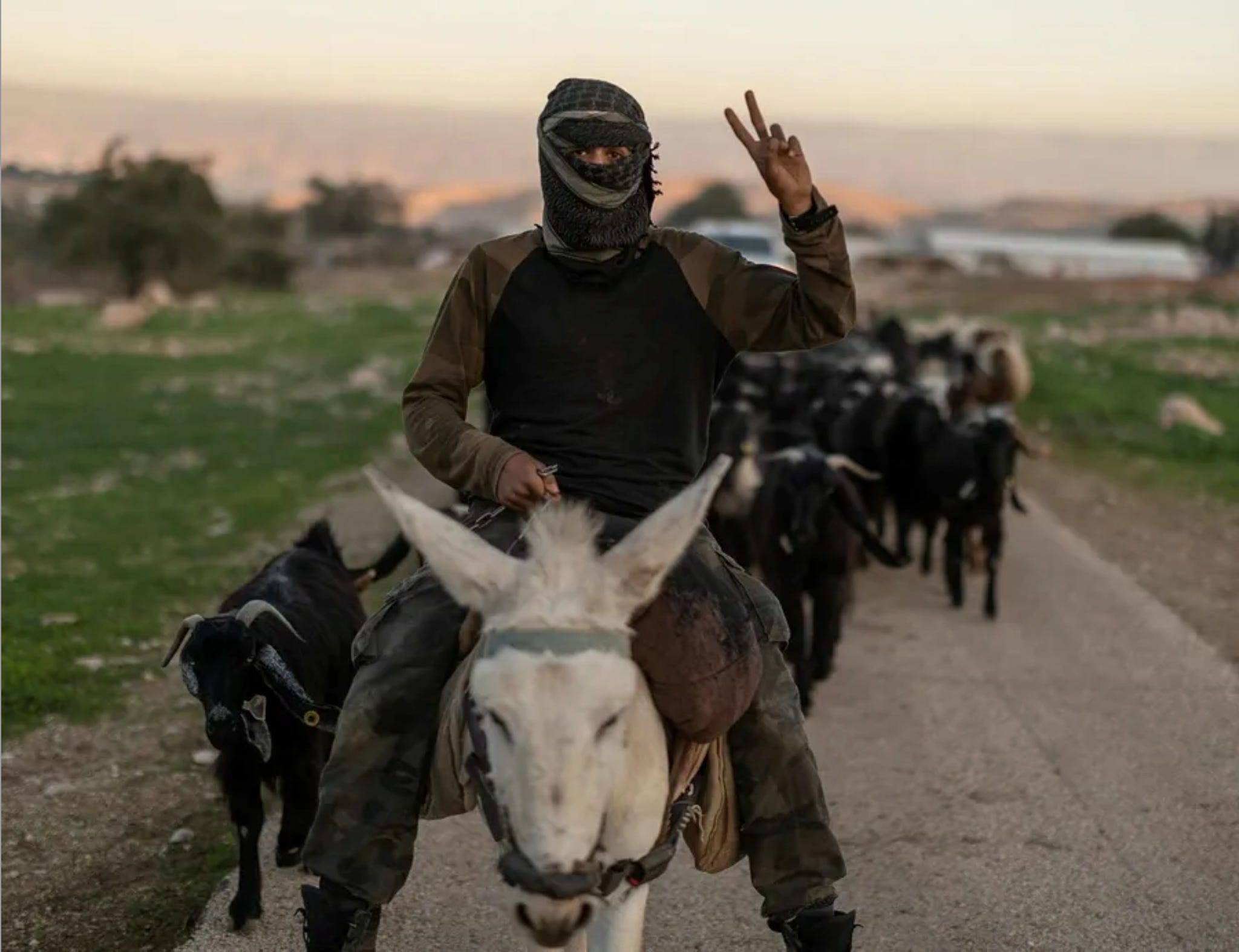
Scanning the news, I see the same boy we observed herding goats, now riding a donkey, his face wrapped in a kufiya, his hand raised in a V sign. He believes this is a game. He believes he has won.
Faced with a growing urgency to write about my experience there, I ask friends to read drafts of this essay. They ask in turn whom I am writing for—Jews who already agree with me, family members who may not, or non-Jewish friends who care but sometimes reveal how little they know. “Is this a call to action?” asks one friend, a veteran activist and writer. I don’t have a simple answer, only the sense that speaking is itself a form of teshuvah, a refusal to normalize what I have seen.
And this much I know, from the embodied memory of Ras ‘Ein al-’Auja and from the Torah with which I was raised: the real terror is not an external enemy, endlessly invoked to justify violence. It is what we—the abstract, diverse, complicated Jewish collective—have become capable of. It is the figure of the settler youth, shaped and unleashed by a system that has abandoned ethical restraint, if it ever possessed it. And our teshuvah, as Jews in the Diaspora and on the Land, is to turn toward that danger within—to confront our collective moral disorientation and refuse it.
This is powerful and deeply moving in its raw eloquence. Thank you for being present for this and for sharing it with us.
Thank you Julie. Gut Shabbos