

The Talmud says that an uninterpreted dream is like an unopened letter. This essay follows a series of messages that arrived before I knew how to read them: a recording, a dream, and a journey retracing Walter Benjamin’s final crossing into Spain.
In 2009, I asked the poet and songwriter David Berman to record himself saying a single sentence over and over: “I don’t know, Adonai.” My plan was to use it as a track for a video artwork.
Adonai is the spoken substitute for the four-letter name of god, considered too holy to pronounce.
He sent the file a few weeks later. The recording was simple, but I found it impossible to use. In David’s voice, the words carried more weight than I knew what to do with.
Ten years later, David took his own life. The night before I learned of his death, I dreamt I was trapped in an old station wagon plunging into the ocean’s depths. The water rose around me as I fumbled with the door. I woke up just before the car submerged.
When I heard the news of his suicide the next day, I thought of the dream as a message that had already arrived, waiting to be read. As I struggled to escape the sinking car, he seemed to disappear into the ocean’s darkness.
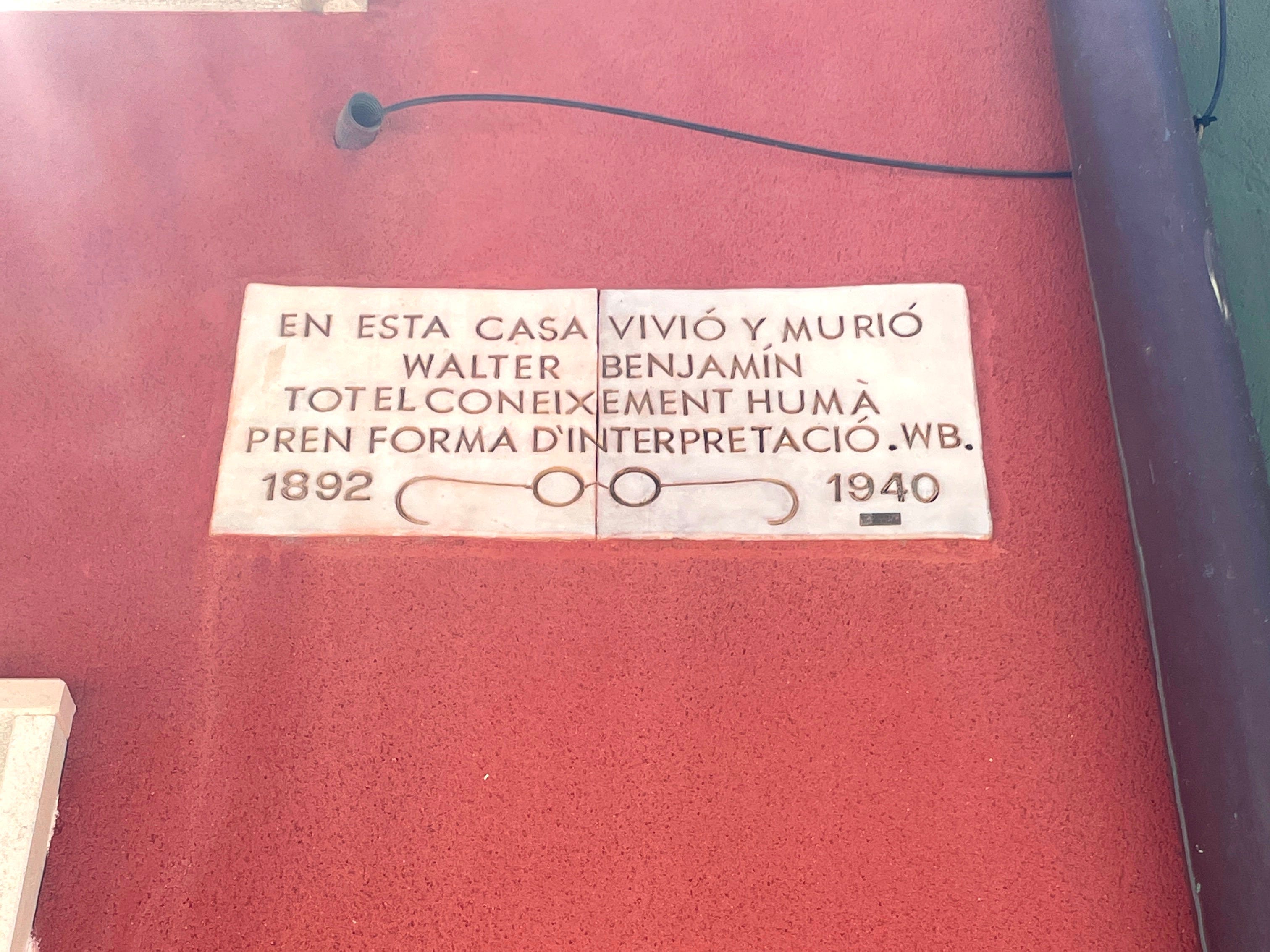
Recently, I made a pilgrimage to the grave of the Jewish philosopher Walter Benjamin in Portbou, Spain. Exiled in Paris in 1933 and later stripped of his German citizenship, he fled Nazi-occupied France in 1940 along a steep mountain route over the Pyrenees.
On a warm day in late spring, I retraced his path. Climbing through vineyards before crossing onto the mountain’s shadowed side, where deeper ridges rose to the north, I stopped at a small spring marked by a sign explaining that Benjamin had also rested there, alongside Lisa Fittko, the anti-fascist Jewish woman who guided hundreds of refugees along this route into Spain.
During the hike, David’s voice—repeating “I don’t know, Adonai”—returned to me. I had chosen this difficult climb, pausing to turn back toward the sunlight sparkling across the cerulean Mediterranean. But with each step up the rugged path, I imagined the weight of this crossing for Benjamin.
How far can a person go when there appears to be no way forward?
Benjamin, exhausted by years of displacement, carried with him a heavy suitcase said to contain a manuscript that would later disappear into legend. Behind him, the threat of the Nazis; ahead, the uncertainty of the border. Not knowing when, or if, this journey would end.
I thought of those making similar journeys today, across forests and deserts, over mountains, in overcrowded boats crossing dangerous waters, in search of safety and the possibility of a future.
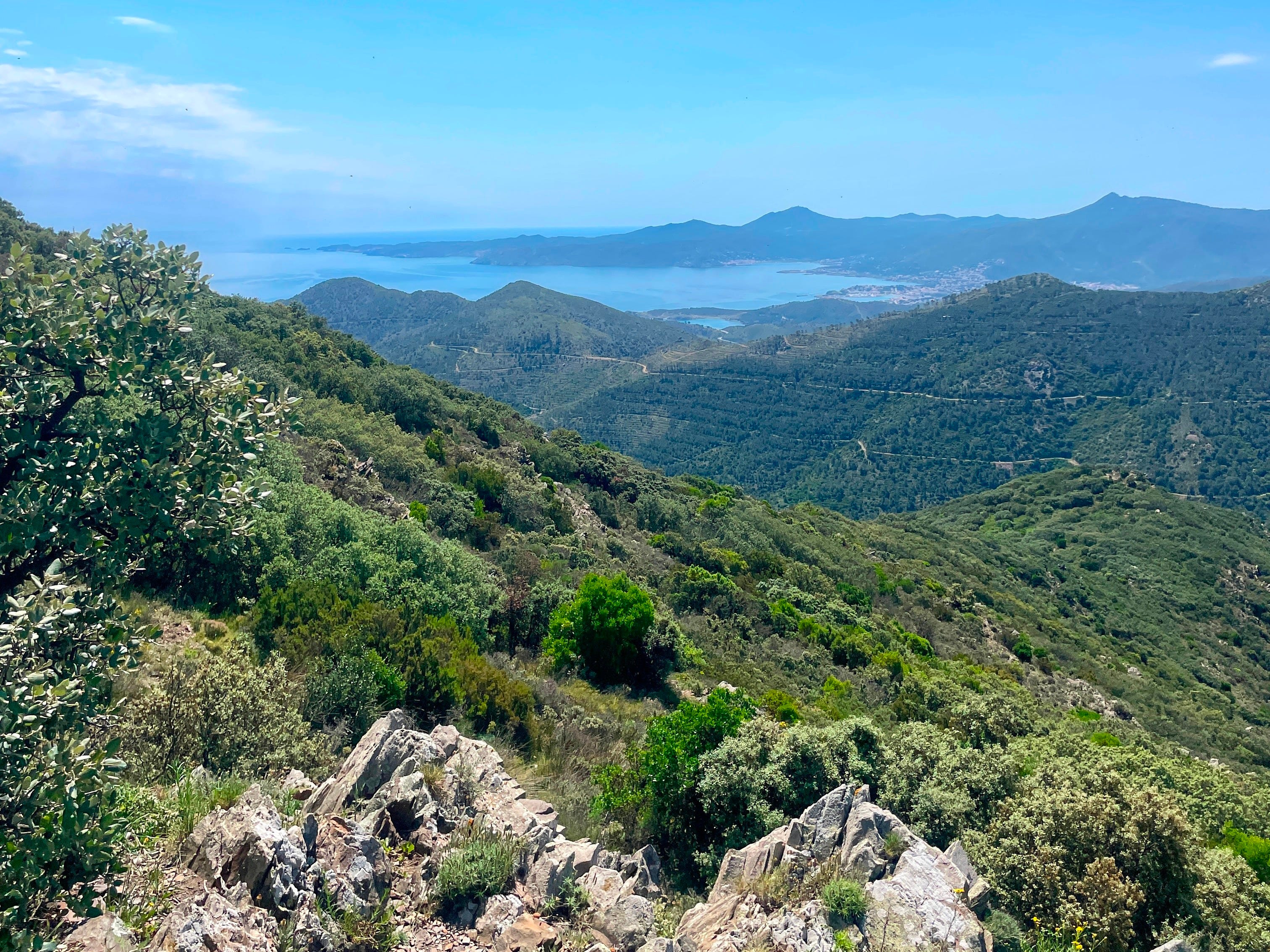
The final ridge into Spain is called the “Hill of Freedom”: cascading peaks dotted with yellow Spanish broom, sage, and juniper, opening onto a wide horizon where the blue of the sea blurs into the sky. Standing there, I understood why Benjamin carried morphine tablets on this journey—not simply as a means of death, but as a final measure of agency should every other path be closed.
How long did that sense of freedom last, I wondered, before he was stopped by Spanish border police?
After authorities threatened to return him to France the next morning, Benjamin spent his final night in a hotel room in Portbou. He wrote: “In a situation presenting no way out, I have no other choice but to make an end of it. It is in a small village in the Pyrenees, where no one knows me, that my life will come to a close.”
I don’t know how I would have faced such a moment—the threat of return, the collapse of all remaining paths.
To say “I don’t know, Adonai” is to stand before the unknowable and remain there, not as surrender, but as a refusal to mistake certainty for truth.
David never sought fame, and he was a generous artist. Our correspondence began with a question I couldn’t shake. In 2009, I wrote to him asking why, in the 2007 documentary Silver Jew about his band’s tour in Israel, he never mentioned the violence of the occupation or apartheid, the experiences of Palestinians, or the 2006 Israeli attack on southern Lebanon. That question sparked a correspondence that lasted until his death.
The film offered a rare aperture into this reclusive musician’s life. In it, he speaks casually about Jewish mysticism, shares stories about his evolution as an artist, and asks a pet-store owner for a Jewish gift for his dog. But what stayed with me most was watching him break down in tears while praying at the Kotel. In that moment, I felt the weight of what he carried: addiction, earlier suicide attempts, and a fragile rediscovery of Judaism in sobriety. I also felt my own estrangement from Judaism stirring, shaped by the violence I had personally encountered in Israel/Palestine and the zionist myths I had been raised on.
Not knowing is not an obstacle but a condition. Sometimes it leads to discovery; sometimes it leads to a dead end.
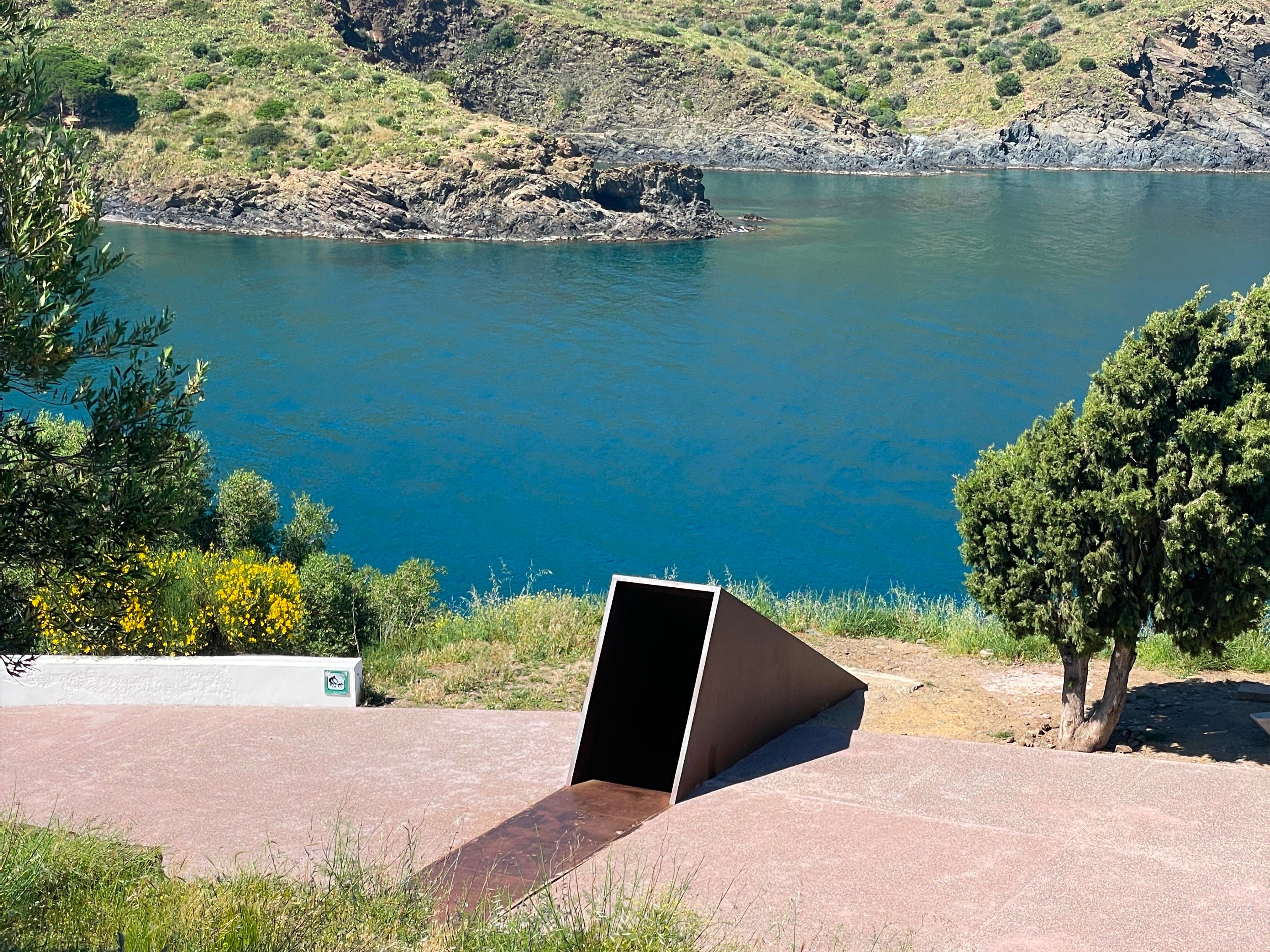
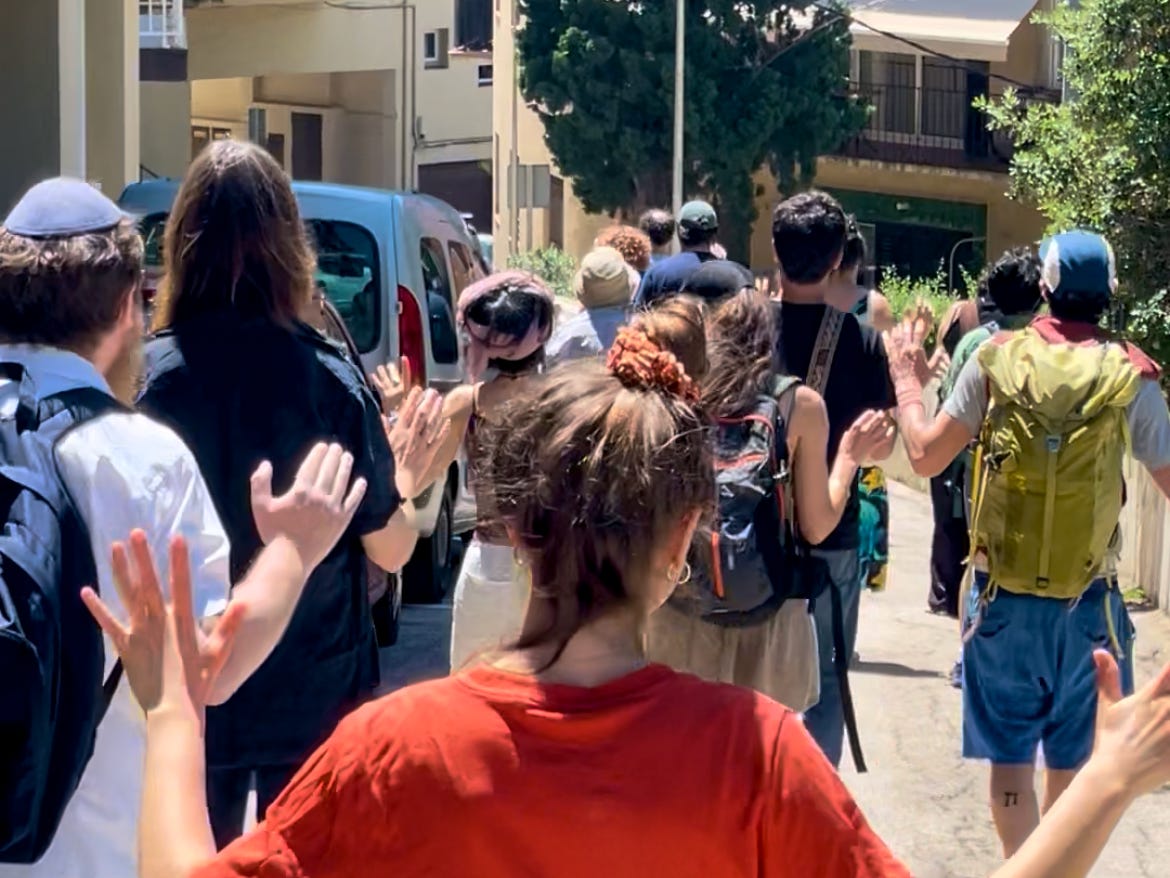
Benjamin’s grave rests in a Catholic cemetery overlooking the sea. Nearby stands the memorial Passagen by the artist Dani Karavan. I guided a group of diasporic Jews up the hill to the site, inviting them to walk backwards. We faced the valley through which Benjamin had entered Spain, the sea behind us, our arms lifted like the Angelus Novus from Paul Klee’s drawing, made famous by Benjamin’s description of it in his Theses on the Philosophy of History.
One by one, we entered the memorial: a staircase flanked by steel walls, descending toward a point suspended over the ocean, sealed by a thick glass barrier. Benjamin’s words are engraved on the glass in five languages: “It is more difficult to honor the memory of the anonymous than that of the renowned. Historical construction is devoted to the memory of the anonymous.”
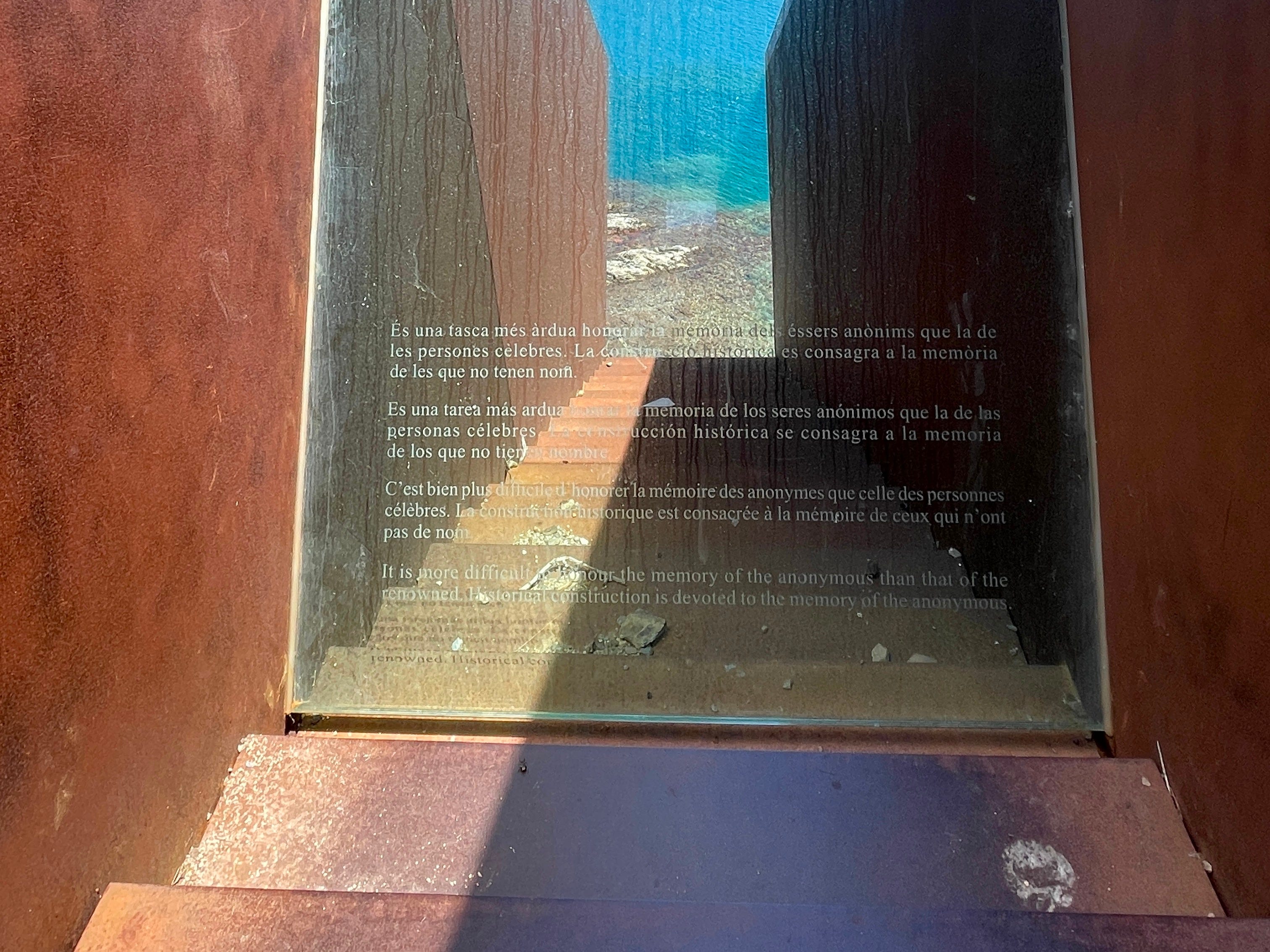
Stories of escape do not elude us. They linger, like the slow movement of a mountain’s shadow across a valley. On this pilgrimage, I was among Jewish activists, poets, philosophers and ritualists, many of whom carry multiple passports—documents born of generations of forced migration, now conferring a mobility our ancestors did not have.
We gathered to grieve the ongoing violence of the present, to honor Benjamin’s memory, and to study together during Shavuot, the holiday marking the receiving of the Torah. Following tradition, we studied through the night, choosing to read and discuss Benjamin’s theses. After hours of conversation—about marxism, mysticism, memory, and redemption—bleary-eyed and nearly voiceless, we stepped outside to greet the sun rising over the sea.
What does it mean to face the past while suspended in the present, our backs turned to the unknown future?
I don’t know. And it is in this unknowing that I choose to remain.
P.S. It was only after David’s death that I was able to use his recording. It appears in this video artwork featuring an early version of my Tzadik character in ecstatic dance.
You can hear more about my friendship with David in a radio interview with Sam Hatchwell and Jeremy Lev Steinberger on World Refugee Radio in Berlin. And check out Sam’s remixing of David’s track in his new release, Shalom Aleichem feat David Berman.
Julie, this essay holds unknowing with rare moral and spiritual seriousness. David Berman’s repeated “I don’t know, Adonai,” the dream of the sinking car, Benjamin’s final crossing, and the glass barrier overlooking the sea all seem to gather around the same ache: what it means to stand before history, grief, exile, violence, and death without forcing them into a certainty too small to hold them. I was especially moved by the way the pilgrimage becomes more than remembrance; it becomes a practice of facing the past while remaining suspended in the unfinished present. The line “not knowing is not an obstacle but a condition” feels like the center of the piece, because it gives uncertainty dignity, and lets refusal, mourning, faith, and witness remain alive together.
Thank you, Jules.
Your words resonates deeply with me. Especially the sound of your friend Berman's z'l words: “I don't know, Adonai.”
I find myself carrying a grief for Israel, both the land and its people, that feels increasingly polarized, and for a progressive world that often seems unable to hold complexity. Grief, too, for a Mokum (Amsterdam) that no longer feels equally safe to all who once called it our safe place.
And yet, every now and then, something breaks through the noise. I join demonstrations for a free Iran wearing a kippah, and Persian strangers embrace me. They say, “Am Yisrael Chai.”
Like you, I find myself returning to memory. In my own work as a curator, preparing an upcoming exhibition about forgotten women artists, I keep encountering Benjamin's question: how do we honor those who are disappearing from view?
As I read your words, I found myself touching my tzitzit. In this week's parasha we read about the tzitzit: “Ure’item oto, uzechartem et kol mitzvot Adonai”, “You shall see it and remember all the commandments of Adonai.”
Perhaps that is the question I carry forward from your piece: how do we remain faithful to those commandments when certainty is tearing the world apart? How do we continue choosing chesed?
I hear the voice repeating, “Adonai, I don't know.”
And so I keep touching the thread.